



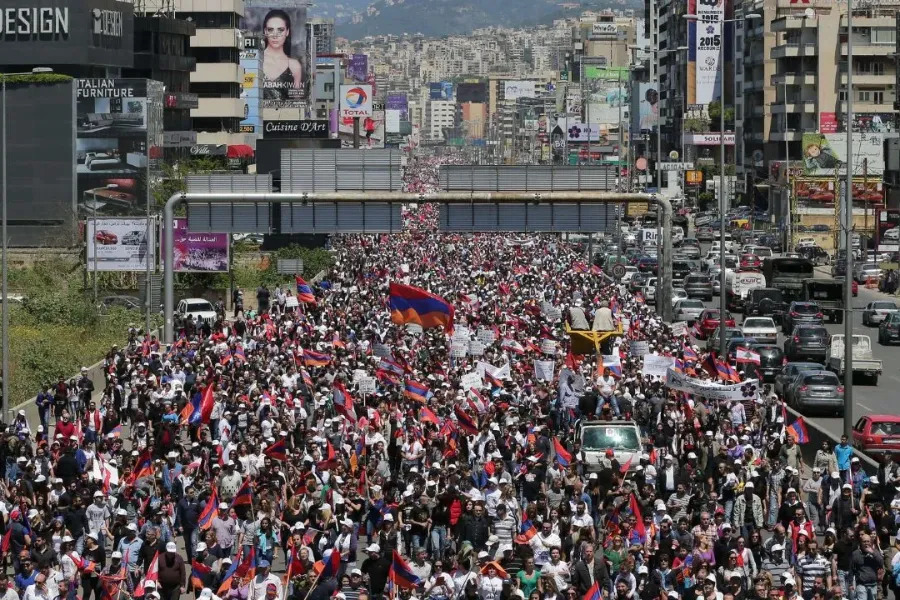
Consociational democracy is the defining characteristic of Lebanon’s sociopolitical structure. In this context, the Armenian community in Lebanon is among the most significant in the global Armenian diaspora. Primarily formed in the 1920s, for decades, it has also fueled the growth of the diaspora, with many Lebanese Armenians becoming prominent diaspora figures in numerous communities globally. Some, following the independence of Armenia from the Soviet Union, moved there, built their lives and began contributing to the development of the homeland. Others sacrificed what they held most precious — their lives — for the Armenian people.
Regardless, the Lebanese Armenian community remains a critical case study to understand the sociopolitical, cultural and economic nature of the Armenian people, as Lebanon remains the most prominent diaspora community where Lebanese Armenians not only became citizens but also participants in successive governments as ministers and in parliament as lawmakers, alongside party leaders, deputy central bank governors, military figures, etc.
However, the history of the Lebanese Armenian community remains understudied, vast and ever-growing, both historically and politically.
Arrival in Lebanon
During the reign of Tigranes the Great (95–55 B.C.), a number of Armenians settled in Phoenician territories. Since then, the community has existed almost continuously. Moreover, Roman historians indicate that even before Christ, Armenian merchants brought wine, fruit and cochineal dye from Armenia to markets in the region. Later, during the Seljuk invasions, thousands of Armenians migrated from Armenia to Cilicia, Syria and parts of Lebanon.
In the 12th and 13th centuries, Armenian communities were documented in Lebanese cities, expanding further after the fall of the Armenian Kingdom of Cilicia. The Crusades also encouraged Armenian migration to these territories, where Crusader principalities or kingdoms were established.
In the 1600s, a wave of Armenian Catholics found refuge in Lebanon, fleeing Ottoman persecution. In 1832, another major influx of Armenians arrived in Lebanon due to unfavorable socioeconomic conditions in Anatolia and persecution in Ottoman territories by Kurdish militias.
When the Mount Lebanon Mutasarrifate was declared in 1861, the first administrator of this new structure became Armenian Catholic Garabet Artin Davoudian (1861–1868), better known as Daoud Pasha. Previously, he had served as telegraph director in Constantinople. Another Armenian, Ohannes Kouyoumdjian Pasha, became the last administrator of the Mount Lebanon Mutasarrifate (1912–1915).
However, the Armenian Genocide, organized by the Committee of Union and Progress and beginning in 1915, led to the deportation and massacre of approximately 1.5 million to 2 million Armenians, many of whom settled in what are today Syria, Lebanon, Palestine and Iraq. Others immigrated to France, the United States and Canada.
Between 1920 and 1930, the Armenian Apostolic, Catholic and Protestant churches worked together to organize communal life and provide housing for refugees (Tashjian, 2020, p. 4). In 1922, a larger number of Armenians entered Lebanon after France ceded the Cilicia region to Kemalist Turkey (Abramson, 2013, p. 191). Finally, in 1939, another wave of Armenian migrants, numbering approximately 20,000 people, arrived in Lebanon following the conflict over Musa Dagh and the well-known 40-day resistance of Armenians, who were ultimately rescued by the French navy and resettled in what is now Anjar.
In 1924, Armenians in Lebanon received national ID cards even before the declaration of Lebanon’s constitution in 1926. The overwhelming majority lived in Beirut and were mainly small traders, wealthy individuals and intellectuals. Over time, Armenian refugees integrated into Lebanon’s political life and culture and became citizens. In the 1950s, Lebanese Armenians — like most political groups in the country — experienced internal struggles and ideological disagreements.
Origins of the three Armenian denominations
The institutionalization of Armenian life in Lebanon was not only political but also ecclesiastical, with denominational structures playing a central role in organizing communal identity and governance.
Catholic Armenians
In 1721, the Armenian Catholic Andonian Order built the Monastery of Our Savior in Kreim, near the village of Ghosta. In 1865, the Syriac Maronite Bishop Youhanna Habib bought the monastery after the Armenian monks had left for nearby Bzommar.
Years later, Abraham Petros I Ardzivian, the first Armenian Catholic catholicos, following official recognition by Pope Benedict XIV in 1742, ordered the construction of the Armenian Catholic Monastery of Bzommar, which served as the Catholicosate until 1766. Most Armenian Catholic migrants were gradually assimilated. Many Armenian Catholics of this period integrated quickly into Lebanese public life, and many adopted Arabic names, such as Abdullah Ishaq, the first Armenian Catholic and first Armenian member of the Lebanese parliament representing the minorities seat.
Orthodox Armenians
“Early in 1921-1922, 20,000 Armenians settled in tents at the eastern entrance of Beirut” (Messerlian, 2014, p. 7). However, during this period, St. Nishan Cathedral had been established as a station for Armenian pilgrims traveling to Jerusalem in the 19th century. Although it was destroyed by Ottoman authorities during World War I, it was later rebuilt with the support of Catholicos Sahag II of the Great House of Cilicia and the French Mandate in 1938, with financial support and efforts from Armenians in Lebanon.
In the 1920s, the Armenian prelacy in Lebanon was formally established under the Holy See of Cilicia, with its institutions gradually taking shape. In 1951, the prelacy had its first official leader: Bishop Khoren Paroyan (1951–1963), who was elected as the first prelate of the Armenian Prelacy of Lebanon and later became Catholicos Khoren I (1963-1983).
Protestant Armenians
The Armenian Evangelical Church was established in 1846 in Constantinople. It is a member of the World Council of Churches and the Union of Armenian Evangelical Churches in the Near East (Messerlian, 2014, p. 16).
In 1922-1926, Armenian Evangelical life in Lebanon took shape as two congregations gradually evolved into separate institutions, with one relocating to Achrafieh and the other establishing a permanent sanctuary by 1949 in Hamra. Supported by diaspora contributions, new churches and schools emerged.
Conclusion
As such, Lebanon represents the most developed case of Armenian diaspora institutionalization, where identity, political participation and communal autonomy intersect within a consociational framework. Understanding its formation provides critical insight into broader questions of diaspora identity, state integration and minority politics in the Middle East.




Leave a comment